Illinois & Chicago Rental Law Changes for 2026: A Landlord's Compliance Guide
The rental-fee overhaul is now law — but the final version is far less drastic than early drafts. Here's what survived, what didn't, and what Chicago landlords must do before January 1, 2027.
Editor's note: This article was originally published June 25, 2026 — one day before Governor Pritzker signed HB 3564 into law. It has been updated and re-verified against the enrolled text of the statute. Several provisions widely reported during the bill's amendment process, including a move-in fee cap and late-fee limits, did not make it into the final law. This version reflects what was actually enacted.
2026 is a turning point for Chicago landlords
If you own or rent out property in Chicago, this year brings the most significant shift in landlord-tenant rules in a decade. One state law is already in force, a second was signed on June 26 and takes effect January 1, 2027, and the City of Chicago has formally introduced an ordinance that would go further than both.
Here's the headline most coverage has missed: the law that ultimately passed is meaningfully narrower than the versions that circulated for the past year. Through nine rounds of amendments — and sustained advocacy from Illinois REALTORS, the Chicagoland Apartment Association, and housing providers across the state — some of the most disruptive proposals were negotiated out before final passage. That's a genuine win for the industry, and owners should understand exactly what they kept. At the same time, the transparency requirements and fee bans that survived are real, enforceable, and carry attorney's-fee exposure for owners who ignore them.
Below is a plain-English breakdown, verified against the enrolled statute — not the outdated summaries still circulating online. (This article is general information, not legal advice — see the note at the end.)
Change #1: The Summary of Rights for Safer Homes Act (in effect now)
As of January 1, 2026, every written residential lease and lease renewal in Illinois must include the state's official "Summary of Rights for Safer Homes" as the first pages of the agreement. This isn't optional boilerplate you can paraphrase — the law requires the full, unabridged summary, published by the Illinois Department of Human Rights, and every tenant named on the lease must sign each page acknowledging receipt.
The summary informs tenants of their protections as survivors of domestic or sexual violence, including the right to terminate a lease early without penalty under qualifying circumstances, the right to change or re-key locks, and protection from eviction or discrimination based on incidents of abuse.
Why it matters to owners: compliance is cheap, but non-compliance is not. A landlord who fails to include the summary can be liable to the tenant for $100 or actual damages up to $2,000, whichever is greater, plus the tenant's attorney's fees and costs. If you can't produce the signed pages, the law presumes you didn't comply. Every lease template you use needs these pages today.
Change #2: HB 3564 — the Rental Fee Transparency and Limitations Act
This is the big one. Governor Pritzker signed HB 3564 on June 26, 2026. It amends the state's Landlord and Tenant Act by adding a new "rental fee transparency and limitations" section. A companion trailer bill, HB 5234, signed the same day, moves the effective date from July 1, 2026 to January 1, 2027 — a delay negotiated specifically to give housing providers a full lease cycle to prepare. Use it.
What the industry won
The bill that passed is not the bill that was introduced, and the difference matters to your bottom line. Provisions that appeared in earlier versions — and that you may still see reported as law — were removed before final passage:
- Move-in fees survived. Early versions banned them outright; a later draft capped them at a fraction of monthly rent and barred charging both a move-in fee and a security deposit. None of that became law. The final statute does not restrict move-in fees or security deposits. For Chicago operators who moved to the fee model precisely to avoid the RLTO's punitive security-deposit litigation environment, this is the single most important thing preserved.
- No late-fee caps. Intermediate drafts imposed a statewide late-fee formula and timing rules. The final law is silent on late fees — existing law (including the RLTO for Chicago units) continues to govern.
- No security deposit cap. The one-month deposit limit from earlier drafts was dropped.
- A workable application fee. The original bill effectively barred application charges; the final version allows up to $50, with a documented pass-through for higher third-party screening costs.
- A real runway. The January 1, 2027 effective date replaced the original July 1, 2026 date.
What owners must still do
The transparency regime and the fee bans that survived have teeth. Starting January 1, 2027, for covered properties:
The banned list. No landlord or lease may require a tenant to pay any of the following eleven categories: application or background-check fees over $50 (except as described below); fees ancillary to the application that duplicate screening costs or bundle in unrelated charges; lease modification or renewal fees; eviction notice or filing fees charged before a court grants an eviction order (court costs remain recoverable through the case itself); after-hours maintenance request fees; fees for contacting the owner or manager about maintenance, lease questions, or anything tenancy-related; travel fees for maintenance or safety repairs; maintenance hotline fees; routine maintenance and upkeep fees; pest abatement fees where the tenant in no way contributed to the infestation; and fees for the in-person walkthrough at move-in or move-out.
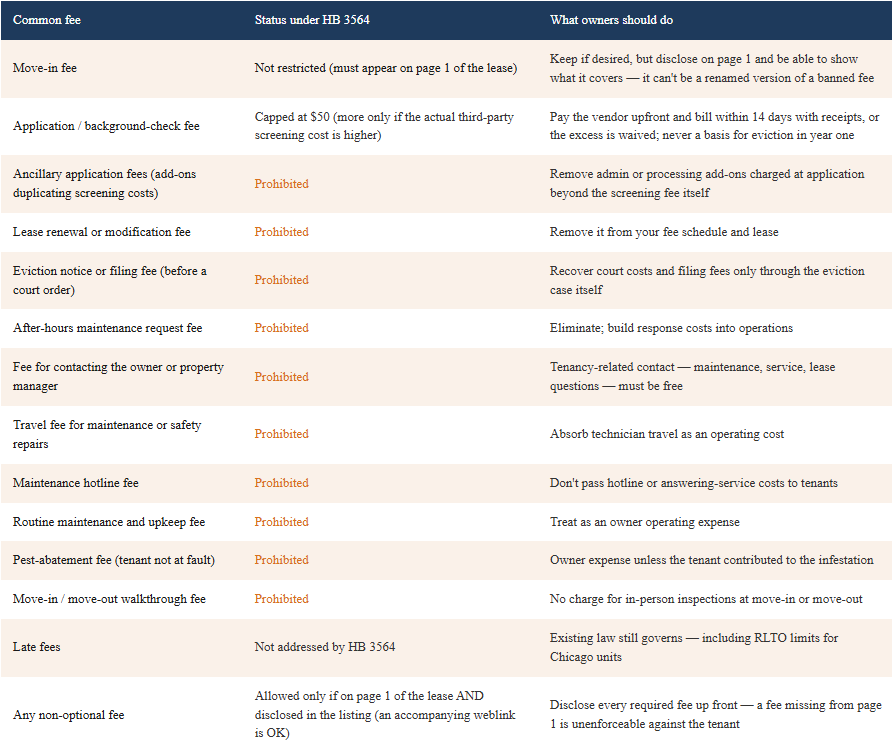
The application fee mechanics. You may charge over $50 only if the actual third-party screening cost exceeds $50, you pay the vendor upfront, and you bill the applicant with receipts within 14 days. Miss the window and the excess is waived. The fee can never be the basis for an eviction action in the first year of the lease.
The disclosure rules. Every non-optional fee — one-time or recurring — must appear on the first page of the lease. A fee missing from page one is simply not owed by the tenant. Non-optional fees must also be disclosed clearly and conspicuously in any listing that includes the rental price, or in an accompanying weblink. And you must state whether utilities are included in the rent.
The anti-renaming clause. You cannot rebrand a banned fee to keep charging it. A "unit servicing fee" that is really a routine maintenance charge will be treated as one.
The enforcement teeth. Any person alleging a violation can bring a civil action and recover injunctive relief, monetary relief, attorney's fees, and costs. Fee-shifting means even a small overlooked charge can become an expensive claim.
On the horizon: Chicago's proposed Protecting Renters Ordinance
Since this article was first published, Mayor Johnson formally introduced the Protecting Renters Ordinance on June 29, sending it directly to the Committee on Housing and Real Estate. It goes well beyond the state law: a ban on hidden "junk" fees with a requirement that charges reflect actual documented costs, a Tenant Bill of Rights, mandatory disclosure of algorithmic pricing tools, a citywide rental registry with annual per-unit fees, a just-cause eviction requirement with relocation assistance for no-fault removals, a one-month cap on security deposits, and a new Bureau of Rental Housing Services to enforce it all. The committee chair has signaled a possible full Council vote this fall.
For Chicago owners, this is the one to watch. The protections the industry successfully kept out of the state law — deposit caps, move-in fee restrictions — are back on the table at the city level, with more besides.
The real impact on owners
The final law is a mixed result, and owners should be clear-eyed about both sides.
On the win side: the core pricing flexibility of the fee model survives. Move-in fees, security deposits, and late-fee structures remain yours to design (subject to existing law and, in Chicago, the RLTO). The doomsday revenue scenarios from early drafts didn't materialize.
On the burden side:
- Real revenue lines still disappear. Renewal fees, after-hours charges, maintenance and hotline fees, travel fees, and no-fault pest charges are gone. Portfolios that budgeted around them take a direct hit.
- The compliance burden is significant. Every lease template must be rebuilt around the page-one disclosure rule, every listing updated, and staff retrained on the banned list and the 14-day application-fee mechanics.
- Legal exposure is asymmetric. With a private right of action and attorney's-fee shifting, a single missing disclosure can cost far more than the fee itself.
- Pricing strategy needs rework. Costs previously recovered through now-banned fees — routine maintenance, administration — don't vanish; they must be folded into base rent or absorbed.
The overlooked impact on tenants
These laws are written to protect renters, and clearer pricing is a real benefit. But the trade-offs are worth stating honestly:
- Costs reappear as higher base rent. When owners can no longer itemize maintenance and administrative charges, those costs typically roll into the headline rent. The total may not drop — it just shows up in one bigger number, which can affect what a renter qualifies for.
- Screening may tighten. With application fees capped and the pass-through process front-loading costs onto owners, some operators will screen more conservatively rather than process more applications.
- Tighter supply at the margins. Smaller landlords squeezed by lost fee income and compliance costs sometimes raise rents or exit the business, reducing the availability of moderately priced units.
None of this means the rules are unworkable — it means owners who adapt thoughtfully can stay compliant while keeping their properties competitively priced and their tenants well served.
How to stay compliant: a practical checklist
- Update your lease template now to lead with the full Summary of Rights for Safer Homes, signed on every page by every tenant.
- Audit your entire fee schedule against the eleven-item banned list — eliminate renewal/modification fees, after-hours and hotline charges, travel fees, routine maintenance fees, pre-judgment eviction notice fees, no-fault pest fees, and walkthrough fees.
- Keep move-in fees if they work for you — but document what each fee legitimately covers, so it can't be characterized as a renamed banned charge.
- Move required fees to page one of the lease and add them to every listing that shows rent (a weblink works), along with a clear statement of whether utilities are included.
- Build the application-fee process: charge your true cost, and for anything above $50, pay the vendor upfront and bill with receipts within 14 days — calendar it, because missing the deadline waives the excess.
- Re-rate your units so operating costs formerly recovered through banned fees are reflected in base rent.
- Document everything and keep signed acknowledgments — the burden of proving disclosure falls on you.
- Verify what you read. This bill went through nine amendments, and much of the guidance online describes versions that never became law. When in doubt, check the enrolled statute or ask your attorney.
How a property management company keeps you compliant
Keeping up with overlapping state and city rules — with a major city ordinance still in motion — is exactly the kind of moving target that catches individual owners off guard. This is where professional management earns its fee:
- Always-current lease documents. A management company maintains attorney-reviewed lease templates and updates them the moment requirements change, so your Safer Homes pages, fee disclosures, and utility statements are always correct.
- A compliant pricing strategy. Using real market-rent data, managers help you re-rate units so income you used to collect through banned fees is recovered legitimately in base rent — without pricing yourself out of the market.
- Clean disclosures across every channel. From the online listing to the signed lease, a manager makes sure required fees are disclosed clearly and consistently, closing the gaps that create tenant claims.
- Systematic recordkeeping. Tenant portals and management software capture signatures, disclosures, and fee receipts automatically — including the 14-day application-fee billing trail — giving you the documentation you'd need if a charge is ever challenged.
- Lower legal exposure. With a private right of action and attorney's-fee shifting in play, having a professional own compliance dramatically reduces the odds of an expensive misstep.
The bottom line
Illinois has moved decisively toward fee transparency — but the law that emerged is one the industry can live with, thanks to a negotiation process that stripped out the most punitive provisions. The Safer Homes lease requirement is already in force; HB 3564's fee rules arrive January 1, 2027; and Chicago's proposed ordinance would raise the stakes again. Owners who use the runway — updating leases, auditing fees, and rethinking how costs are recovered — will adapt smoothly. Those who wait risk lost revenue and tenant claims that come with attorney's fees attached.
Not sure your leases and fees are compliant? We help Chicago owners update their documents, restructure pricing, and stay ahead of every rule change. Reach out to have a discussion about how we can help you through these changes.
Disclaimer: This article is general information, not legal advice. This update is based on the enrolled text of HB 3564 as signed June 26, 2026 (effective January 1, 2027 pursuant to HB 5234); Chicago's Protecting Renters Ordinance remains a proposal and is subject to change. Consult a qualified Illinois attorney or a licensed property manager before making decisions about your leases or fees.